







AI Overviews Are Here! Latest SEO & GEO Optimization Strategies and Industry Guide
2025 / 01 / 14
Author: Arachne Group Limited Senior SEO Strategist丨Last Updated: July 22, 2026丨Estimated Reading Time: 3 minutes
Google has officially rolled out AI Overviews (AIO, formerly known as SGE), which uses AI to generate comprehensive answers directly at the top of search results. This change is directly impacting the organic traffic of traditional websites.
Facing the “Zero-Click Search” trend, how should websites respond? In this article, the professional SEO team at Arachne Group Limited breaks down the operating mechanism of AIO, the industries most affected, and provides practical GEO (Generative Engine Optimization) strategies.
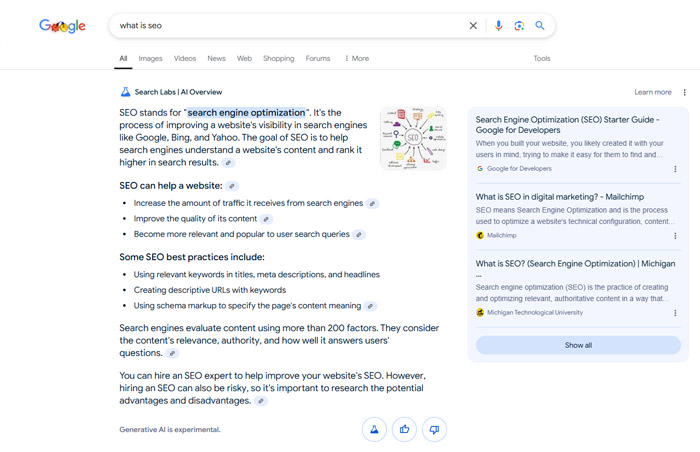
AI Overviews is Google’s search feature that integrates Large Language Models (LLMs). When users enter complex or informational queries, AIO automatically aggregates content from multiple web pages at the top of the search results, providing summarized answers and cited links.
Although AIO faced controversy in its early launch due to “AI hallucinations,” and Google temporarily reduced its appearance rate, recent data shows that Google is gradually refining the model and increasing AIO coverage in specific high-value areas.
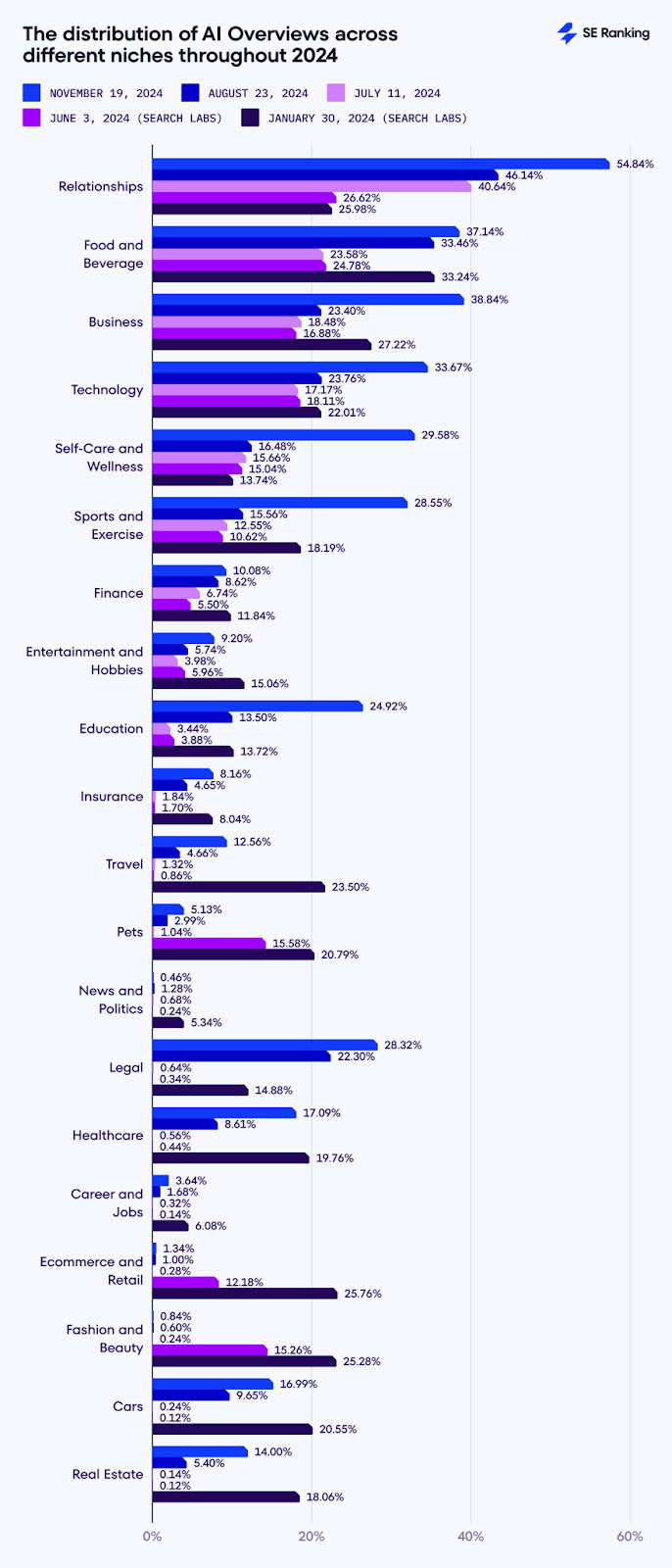
According to SE Ranking’s tracking data across 20 industries and more than 10 keywords, approximately 18.76% of keywords trigger AI Overviews. However, there are significant differences in trigger rates across industries:
HKWEB Practical Observations:
Informational keywords (How-to, concept definitions) are the most easily captured by AIO. Although AI answers may divert some basic traffic, current AI summaries still tend to be shallow and formatted in a fixed style. In-depth analysis, exclusive data, and expert experience remain the core value of websites that AI cannot fully replace.
To ensure your website content continues to gain visibility in the AI era and is selected by AIO as a citation source, marketers need to shift toward a GEO (Generative Engine Optimization) framework:
Directly below H2 headings, use 50–80 word concise answer paragraphs to define the core question. AI engines strongly favor this clear, structured text that can be used directly as answer summaries.
Fully implement JSON-LD structured data for Article, FAQPage, and Organization, and clearly mark author and publisher. This lowers the barrier for LLMs to parse webpage structure and increases crawlability.
Avoid simply reorganizing existing online information. Include your team’s exclusive research, practical cases, or comparison charts in your content. This type of “non-AI-generatable” original content is currently AIO’s highest-priority authoritative citation source.
AI model training and real-time retrieval heavily rely on major news outlets and authoritative media. Through press releases, high-quality backlinks, and brand mentions, link your brand name with specific industry keywords to increase visibility in AIO answers.
Build a loyal audience through email newsletters (EDM), social media, and direct traffic to minimize the impact of single search engine algorithm changes on website operations.
A1: AI Overviews (AIO) is Google’s official AI search feature that automatically integrates content from multiple web pages at the top of the SERP to generate comprehensive summaries and cited links. SGE (Search Generative Experience) was the experimental name for AIO during its 2023 testing phase. They are essentially the same, but AIO has now entered full production.
A2: Informational keywords are the most likely to trigger AIO. By industry:
A3: GEO (Generative Engine Optimization) is a new strategy for optimizing content for AI answer engines (such as AIO and Perplexity). Unlike traditional SEO, which aims to win the top click position in search results, GEO’s core goal is to have your website content adopted by AI as training data and citation sources.
A4: Four key strategies to improve AIO citations:
Executive Summary
- What are AI Overviews (AIO)? Google’s search feature powered by LLMs that generates comprehensive answers with cited links directly at the top of the SERP. It is the official successor to SGE.
- Which types of websites are most affected? Informational and knowledge-based websites are impacted the most; AIO trigger rates are relatively high in healthcare and legal fields; e-commerce trigger rate is only 1.34%.
- What is GEO strategy? Generative Engine Optimization — using structured data, precise concise answer paragraphs, and E-E-A-T exclusive data to increase the chances of your website being selected as a citation source by AI.
- Key action items: Deploy Direct Answer blocks, implement FAQ/Article Schema, add original test data, and build authoritative external mentions.
Google has officially rolled out AI Overviews (AIO, formerly known as SGE), which uses AI to generate comprehensive answers directly at the top of search results. This change is directly impacting the organic traffic of traditional websites.
Facing the “Zero-Click Search” trend, how should websites respond? In this article, the professional SEO team at Arachne Group Limited breaks down the operating mechanism of AIO, the industries most affected, and provides practical GEO (Generative Engine Optimization) strategies.
What are AI Overviews (AIO)?
AI Overviews is Google’s search feature that integrates Large Language Models (LLMs). When users enter complex or informational queries, AIO automatically aggregates content from multiple web pages at the top of the search results, providing summarized answers and cited links.
Although AIO faced controversy in its early launch due to “AI hallucinations,” and Google temporarily reduced its appearance rate, recent data shows that Google is gradually refining the model and increasing AIO coverage in specific high-value areas.
Which types of websites are most likely to trigger AI Overviews?
According to SE Ranking’s tracking data across 20 industries and more than 10 keywords, approximately 18.76% of keywords trigger AI Overviews. However, there are significant differences in trigger rates across industries:
| Industry | AIO Trigger Rate | Arachne Group Limited Analysis & Recommendations |
| Healthcare | Relatively High | Users prefer instant answers; content requires extremely high E-E-A-T authority. |
| Legal & Insurance | Relatively High | Complex terms; AIO prefers pages that can structurally break down concepts. |
| Informational & Knowledge-based Articles | Extremely High | Primary citation sources for AIO to organize answers; most heavily impacted by “zero-click” searches. |
| E-commerce | 1.34% (Extremely Low) | Involves purchase intent and real-time inventory; still primarily relies on traditional SERP and ads. |
HKWEB Practical Observations:
Informational keywords (How-to, concept definitions) are the most easily captured by AIO. Although AI answers may divert some basic traffic, current AI summaries still tend to be shallow and formatted in a fixed style. In-depth analysis, exclusive data, and expert experience remain the core value of websites that AI cannot fully replace.
Competing in the AI Search Era: 5 Major GEO & SEO Strategies
To ensure your website content continues to gain visibility in the AI era and is selected by AIO as a citation source, marketers need to shift toward a GEO (Generative Engine Optimization) framework:
1. Deploy “Direct Answer Blocks”
Directly below H2 headings, use 50–80 word concise answer paragraphs to define the core question. AI engines strongly favor this clear, structured text that can be used directly as answer summaries.
2. Perfect Schema Structured Data
Fully implement JSON-LD structured data for Article, FAQPage, and Organization, and clearly mark author and publisher. This lowers the barrier for LLMs to parse webpage structure and increases crawlability.
3. Add Exclusive Test Data and First-Person Experience (E-E-A-T)
Avoid simply reorganizing existing online information. Include your team’s exclusive research, practical cases, or comparison charts in your content. This type of “non-AI-generatable” original content is currently AIO’s highest-priority authoritative citation source.
4. Build High-Authority Media Mentions & External References (Entity Authority)
AI model training and real-time retrieval heavily rely on major news outlets and authoritative media. Through press releases, high-quality backlinks, and brand mentions, link your brand name with specific industry keywords to increase visibility in AIO answers.
5. Develop Multiple Traffic Channels to Reduce Search Dependency
Build a loyal audience through email newsletters (EDM), social media, and direct traffic to minimize the impact of single search engine algorithm changes on website operations.
FAQ: Common Questions about SEO & GEO Optimization
Q1: What are AI Overviews (AIO)? How do they differ from Google SGE?A1: AI Overviews (AIO) is Google’s official AI search feature that automatically integrates content from multiple web pages at the top of the SERP to generate comprehensive summaries and cited links. SGE (Search Generative Experience) was the experimental name for AIO during its 2023 testing phase. They are essentially the same, but AIO has now entered full production.
Q2: Which industries or keywords are most likely to trigger AI Overviews?
A2: Informational keywords are the most likely to trigger AIO. By industry:
- High trigger rate industries: Healthcare, legal consulting, insurance & finance (approximately 20%–40% trigger rate).
- Low trigger rate industries: E-commerce and product purchase-related keywords (only about 1.34% trigger rate).
Q3: What is GEO (Generative Engine Optimization)? How does it differ from traditional SEO?
A3: GEO (Generative Engine Optimization) is a new strategy for optimizing content for AI answer engines (such as AIO and Perplexity). Unlike traditional SEO, which aims to win the top click position in search results, GEO’s core goal is to have your website content adopted by AI as training data and citation sources.
Q4: How can websites increase their chances of being cited by AI Overviews?
A4: Four key strategies to improve AIO citations:
- Place Direct Answer blocks: Provide a precise 50–80 word summary directly below headings.
- Strengthen E-E-A-T with exclusive data: Offer original research, test data, and expert insights — resources AI cannot automatically generate.
- Deploy JSON-LD structured data: Mark up `FAQPage` and `Article` schemas to help LLM crawlers parse content.
- Gain authoritative external mentions: Build brand associations and external links through mainstream news and professional media.
Conclusion: Embrace GEO and Seize the AI Search Opportunity
The widespread adoption of AI Overviews does not mark the end of traditional SEO, but rather an upgrade to a more demanding GEO (Generative Engine Optimization) approach. By understanding AIO’s citation logic and focusing on highly professional and unique content (E-E-A-T), websites can continue to win traffic and user trust in the AI search era.MORE BLOG
-

How Powerful Is GPT-6.0 Astra Really? Analysis of Web Development, Digital Marketing & Enterprise Applications
2026/09/09 GPT-6.0 Astra marks the agentic AI era. See real gains in web prototyping, front-end QA & digital marketing, plus safe pilot tips for Hong Kong SMEs. -

Old Notes Can Explode Again! Complete Strategy Guide to Extending Content Lifecycle with Xiaohongshu Shutiao
2026/09/04 Revive declining Xiaohongshu notes with Shutiao. Learn 90-day selection criteria, Hong Kong targeting, 5-step delivery strategy & ROI metrics for second traffic waves. -

How Should SMEs Allocate Their SEM Budget? A Guide to Google Ads Monthly Spend from HK$5,000 to 30,000
2026/08/28 How Hong Kong SMEs should allocate Google Ads budgets from HK$5,000 to 30,000. Focus on affordable CPL, high-intent search keywords, Smart Bidding learning periods, and practical allocation tables.

